Waterfall process was built for teams with time and headcount to burn. Modern agencies have neither. Agile isn't a buzzword anymore, it's how small teams ship better products faster, and with AI accelerating every phase of the cycle, the gap between agile shops and everyone else is only getting wider.
Agile used to be a conference buzzword.
Something people nodded along to in presentations and then quietly ignored when they got back to the office and opened up their 47 page requirements document. That era is over. For agencies and product teams working in modern tech stacks, agile isn't a philosophy you adopt. It's the baseline. If your process still moves in a straight line from strategy to design to development to QA to launch, you're shipping slower, learning later, and delivering less than teams half your size.
The argument for agile has always been compelling, but the landscape has shifted in ways that make it practically unavoidable. Consider how fast the tools change. Frontend frameworks evolve quarterly. Platform APIs deprecate features mid project. Device capabilities expand between your kickoff and your launch date. A waterfall process assumes you can define everything up front and execute against a fixed plan. That assumption was shaky ten years ago. Today it's fiction.
But speed is only one part of the equation.
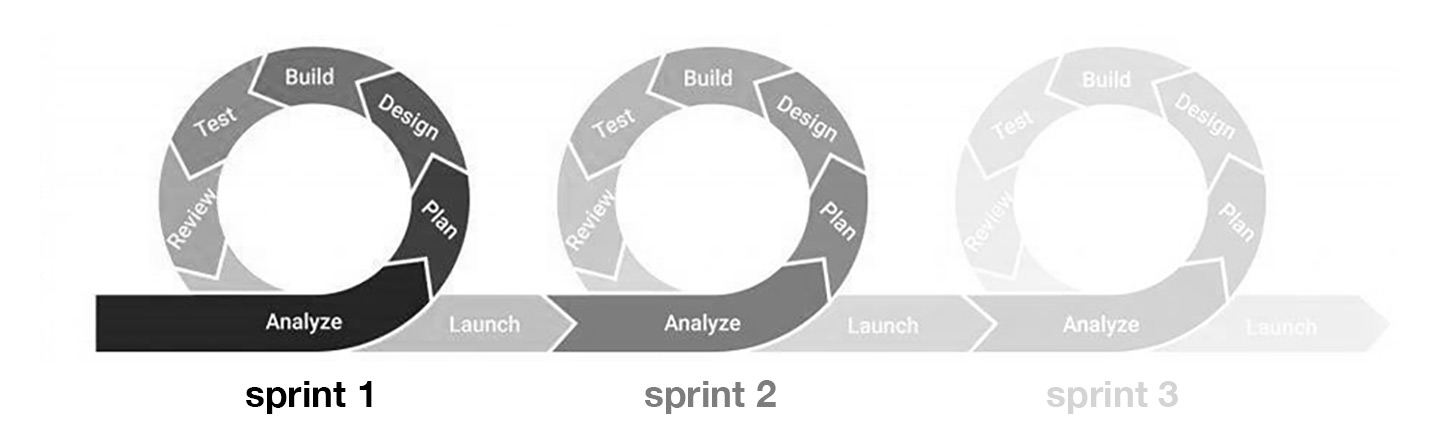
The real power of agile is in the iterations. A waterfall process gives you one shot at design, one shot at development, and one round of testing before launch. An agile process gives you multiple cycles of all three within the same timeline. Every sprint is an opportunity to build, test, learn, and refine. For small teams especially, this is where the magic happens. You don't need a massive QA department if you're testing continuously. You don't need a dedicated UX research team if you're putting working prototypes in front of real users every two weeks.
And this is where AI has fundamentally changed the game for lean agencies. Tools like Claude, GitHub Copilot, Cursor, and v0 aren't replacing designers or developers. They're compressing the time between idea and implementation in ways that would have seemed absurd even two years ago. Need to explore three different component architectures for a complex interaction? What used to take a developer a full day of scaffolding can now be roughed out in an hour. Need to generate test cases, audit accessibility, write documentation, or refactor a messy codebase? AI tooling handles the repetitive groundwork so your team can focus on the decisions that actually require human judgment and taste.
What this means in practice is that a small team running an agile process with AI acceleration can now get through more iterative cycles in the same timeframe than a large team could manage just a few years ago.
More iterations means more opportunities to catch problems early, explore better solutions, and refine the user experience before launch. The quality ceiling goes up because you're not spending your budget on the first pass. You're spending it on the fifth, sixth, and seventh pass, each one tighter and more polished than the last.
The other thing agile does, and this matters enormously for small teams, is tear down the silos between disciplines. In a waterfall process, strategy hands off to design, design hands off to development, and everyone works in isolation until something inevitably breaks at the seams. Agile forces designers, developers, and strategists to work together from day one. When your React developer is in the room while the UX decisions are being made, you don't end up designing interactions that are technically impossible or wildly impractical to build. When your designer sees the real constraints of the component library and the API response shapes, they design solutions that actually work instead of pixel perfect fantasies that fall apart in implementation.
At DBT, this is how we've always operated. Our process is built around rapid prototyping, continuous collaboration, and progressive refinement at every milestone. We review strategy, design, and production together, not as separate checkpoints but as interconnected parts of the same conversation. Working with functional prototypes from the earliest stages means that UX, visual design, and technical architecture are all being considered simultaneously. This is critical when you're solving complex problems because the best solutions almost always live at the intersection of disciplines, not inside any single one of them.
We won't pretend that agile is effortless.
Especially in an agency context. Some clients have internal approval chains that don't bend easily. Some stakeholders need to see a polished deliverable before they trust the process. And running agile well requires genuine trust between the agency and the client, a willingness to collaborate openly and make decisions quickly rather than routing everything through six layers of sign off. It's not the right fit for every project or every client relationship.
But here's what we know for certain: even integrating some agile techniques into a more traditional process will improve your output. Shorter feedback loops. Earlier testing. More collaboration between disciplines. And with AI tooling now capable of handling so much of the mechanical work, there has never been a better time for small teams to embrace this approach. You don't need a 30 person department to ship world class digital products. You need a tight team, a smart process, and the willingness to iterate relentlessly until the work is right.
Ready to go agile? Give these a read:
- Agile Manifesto: Principles - The foundational principles are still worth revisiting. The philosophy hasn't changed, but the tools to execute it have gotten dramatically better.
- Shape Up (Basecamp) - Basecamp's alternative to traditional Scrum that's particularly well suited to small teams and agency work. Worth reading cover to cover.
- Martin Fowler: The New Methodology - Fowler's long running essay on adaptive vs predictive methodologies. A foundational read that holds up remarkably well.
- Atlassian: Agile Project Management Guide - A practical, well maintained resource covering Scrum, Kanban, and hybrid approaches with real world examples.
- AI Assisted Development Workflows (GitHub Blog) - GitHub's ongoing coverage of how AI tooling is reshaping development workflows, from Copilot to code review automation.